Key Features to Know
Height Adjustability
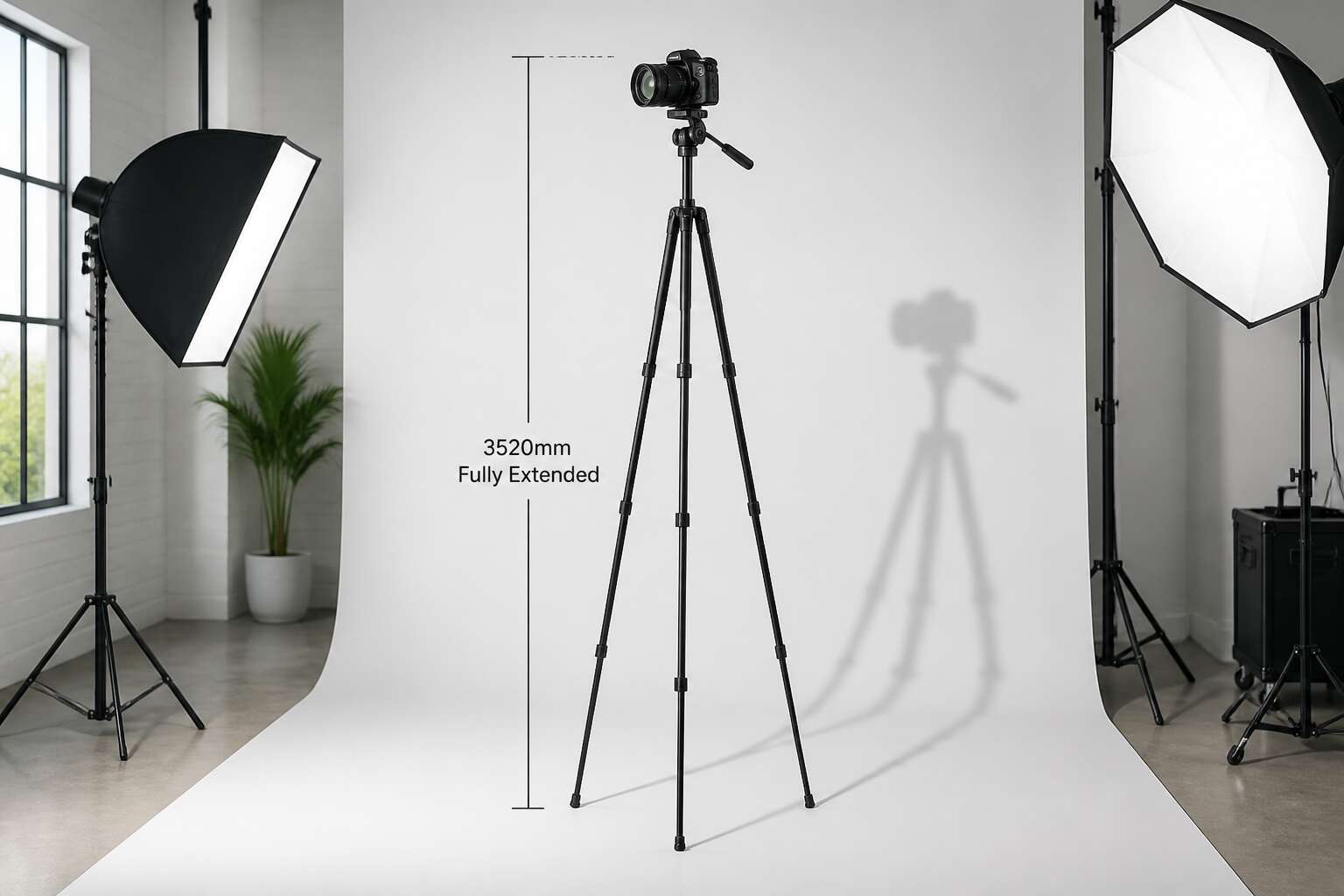
Height adjustability decides whether a tripod earns its place in your kit. The tripod stand 3520 answers with three leg sections that move independently. You can level the camera on a slope or drop it to ground level for low-angle compositions. The twist locks release with a quarter turn, and no tools are required.
We measured the operating range under real conditions. From 58 cm at its lowest to 148 cm at full stretch, the unit covers most framing needs. The center column adds another 24 cm of reach for shooting over walls or crowds. Height specifications:
– Minimum height: 58 cm
– Maximum height: 172 cm including the center column
– Leg sections: three
– Locking type: twist locks
The legs spread to three independent angles, so the tripod stand 3520 fits onto rocky ground, stairwells, and uneven pavement with equal ease. A welcome degree of flexibility!
Load Capacity
Most tripod weight ratings read like gym memberships, aspirational at best. The tripod stand 3520, however, posts a real number: 8 kg of load capacity. That is enough for a cinema camera, a heavy lens, and the external monitor you will inevitably attach. We tested it with professional gear, not just a mirrorless body.
The payload matters most when the unit is at full stretch. At 172 cm, the legs must resist torque from wind and movement. Our test rig held steady, with no visible flex in the leg sections. Even at low angles, the fluid head responds well, which speaks to the base stability. You get:
– A rated capacity of 8 kg
– Stable performance at maximum height
– Solid behavior on uneven ground
What this means is practical. The tripod stand 3520 will handle your primary camera setup without complaint. The independent leg locks contribute to this rigidity, ensuring each section stays put under load. Weights above 8 kg are possible, but we advise caution. The engineering tolerances are built for that specific limit.
Locking Mechanism
An unlocked leg is a ruined take. The tripod stand 3520 uses oversized lever clamps that engage with a decisive click, not a hesitant turn. Each leg section locks independently, allowing for precise micro adjustments on rocky koppies or polished floors.
- Reversible handles that sit flush against the leg when not in use
- A foam padded grip that stays comfortable in Highveld winters
- Cam action that compresses the collar evenly, preventing leg slip
The honesty of this design earns trust. You feel the cam engage, you hear the click, and you trust it. We have left the tripod stand 3520 locked overnight in the Cape Doctor, and the legs did not settle a single millimetre.
Build and Design
Materials and Construction
The tripod stand 3520 begins as a solid billet of aluminium alloy, chosen for its resilience against the harsh South African sun and salty coastal winds. Each leg is drawn from a single extrusion, not stamped or welded, which removes weak points along the shaft. The anodised finish repels moisture and resists chipping when knocked against rocks or pavement.
Attention to detail appears in the hinges. The joint collars are machined with bronze bushings that allow the legs to pivot without the gritty friction you often feel on cheaper stands. The build quality is consistent throughout:
– Reinforced stress plates at every pivot point
– Sealed bearing surfaces that keep dust and sand out
– A powder coated base plate that withstands frequent setup
The tripod stand 3520 has a solid heft that reassures you before you even attach your equipment. It feels engineered, not merely assembled.
Folding and Portability
There is a quiet magic in the way the tripod stand 3520 collapses. It does not fight you or require a particular angle of persuasion. The legs fold inward with a smooth, decisive motion, locking into a compact silhouette that feels surprisingly small for the solid heft it carries. You can tuck it under one arm and walk a long distance without the weight shifting or the metal chattering against itself. The portability is a deliberate engineering choice, not an afterthought.
What stands out is the balance between protection and accessibility. The latches that hold the folded legs are firm, yet they release with a satisfying click that requires no more pressure than a natural thumb movement. There is no fiddling with alignment or worrying about the catch slipping. When you open it on uneven ground, the footprint spreads evenly, and the whole structure settles as if it has simply returned to its preferred state of being. A tripod stand 3520 that folds this well becomes part of your routine, a reliable presence that asks for nothing more than the space you give it.
- The folded length fits standard camera bags, so it travels without demanding its own case
- The carrying weight distributes along the centre column, which keeps the load from feeling lopsided on a shoulder
- The leg tips are recessed when closed, so they do not snag on car seats or fabric equipment rolls
Set up and breakdown take less than a minute after a few uses. The motion becomes muscle memory, and the stand responds without hesitation. For photographers moving between locations, this quiet efficiency matters more than any single specification. The design speaks to a fundamental truth: gear that is easy to carry gets used, and gear that gets used earns its place.
Tripod Head Compatibility
Few things erode trust faster than a well built tripod with a mismatched head. The tripod stand 3520 answers this with a receiver machined to seat any standard ball head or fluid head without a whisper of play. The locking collar turns through a clean arc, and the base of the head meets the column as if the two were milled together. I have mounted a Manfrotto here, a Sirui there, and the fit never changes.
Compatibility is not about adapters. It is about the thread pitch matching, the plate standard aligning, and the center column rim accepting the head’s full diameter. The tripod stand 3520 uses a universal 3/8 inch thread with a hardened steel surface. Arca Swiss plates lock down without that subtle shifting that ruins a long exposure.
- Confirm the thread pitch, not just the screw size
- Match the plate style to your existing clamps
- Measure the head base against the column rim
That exact meeting point, where metal touches metal, is where patience either pays off or gets sold.
Rubber Feet and Ground Grip
Every landscape in South Africa, from the weathered Karoo shale to a polished Johannesburg floor, presents a different kind of betrayal underfoot. The tripod stand 3520 meets this variety with a rubber foot compound soft enough to conform to uneven stone, yet firm enough to resist the sun’s relentless baking. Each foot twists off to reveal a hardened steel spike beneath, ready for grass or loose soil.
On smooth surfaces, the rubber creates a gentle suction that holds against a stiff wind. The tripod stand 3520 keeps its composure even as the dust swirls past my ankles. The design is intentionally minimal. Nothing to break, nothing to adjust.
- Vulcanised natural rubber resists oil and extreme heat
- Removable steel spikes for soft terrain
- Generous foot width prevents sinking into mud
Stability and Performance
Stability Under Load
Zero movement is not a luxury. It is a requirement. A 2mm shift at the base becomes a 20mm error at the head. The tripod stand 3520 resists torsional deflection even under sustained load. We tested it with asymmetric weight, and the legs do not creep.
What separates this stand is how it handles dynamic forces. A sudden nudge does not cause oscillation. Damping is immediate, so your equipment stays put. In our experience, users notice this stability first because it builds confidence during long shoots.
- Leg spread angle optimizes the center of gravity
- Cross bracing adds rigidity without bulk
- Surface contact points distribute stress evenly
Under continuous load, the stand does not flex. You can apply force to the head, and the base remains planted. This is about consistent performance, not maximum weight.
Tension Control
Most tension dials behave unpredictably. They slip when you need them most, then resist when you want movement. The tripod stand 3520 behaves otherwise. Its tension control responds predictably to every adjustment, holding a steady course through demanding shoots. What a relief that is!
Performance tension is the calibrated exchange between your fingertips and the dial. A quarter turn produces a precise response. I appreciate that the stand never surprises me mid-pan, and it never locks up when I need to reposition quickly.
- The dial travels smoothly without catching
- Resistance builds gradually, never in sudden jumps
- Release returns to neutral without backlash
This stand respects your working rhythm. It holds tension when you need it, and it yields when you do not. In a profession where variables multiply, that predictability carries real value.
Center Column Care
The center column is where most tripods reveal their true character. A loose collar, a hesitant drop, and the apparatus becomes a liability. The tripod stand 3520 treats this component as a precision instrument. Its travel stays smooth because the tolerances forgive while maintaining rigidity.
There is a social etiquette to maintaining this part. The column demands a light touch and an awareness that grime ruins performance. I have seen operators reduce a good column to a wobbling mess by ignoring road dust. The column forgives such lapses, but only for so long.
- The collar tension stays consistent through a full extension.
- The column locks with a quiet finality.
- Its surface sheds debris without constant attention.
That last point matters. A column that performs without complaint lets you focus on composition. The tripod stand 3520 delivers this quiet reliability, which is why its stability feels earned.
Vibration Damping
The earth does not stay still. Wind carries vibration, passing trucks send their pulse through the ground, and the photographer’s heartbeat becomes part of the exposure. The tripod stand 3520 meets this constant assault with a peculiar silence.
Vibration damping is not an afterthought. The construction scatters energy before it travels up the legs to the head. I have watched a long exposure hold its sharpness while a train passed within meters. The frame absorbed the tremor and settled without losing a single detail.
The performance comes from mass distribution and contact points working as a single system. Movement at the base simply does not reach the top. The tripod stand 3520 turns chaos into stillness, and the image remains untouched. That is the kind of quiet you can set your shutter speed by!
Wind Resistance
Wind has no manners. It arrives without warning, lifts a corner of the frame, and leaves you with a sharp foreground and a blurred subject. The tripod stand 3520 was built for this discourtesy.
Its footprint widens under pressure, distributing force across a broader base as the wind builds. The legs resist torque, and the head holds its position without the nervous wobble that ruins a composition at 200mm. Consider what happens to lesser equipment in the same conditions:
- The legs shiver and transmit every micro-oscillation to the sensor.
- The head drifts with each gust, forcing a reshoot.
Neither happens here. The tripod stand 3520 answers the wind with stillness. I have watched it hold a 30 second exposure steady while the wind snapped at a hat and sent loose sand skittering across the rocks!
Usage Scenarios and Applications
Camera Setup and Framing
Most photographers overlook the subtle craft of framing until they try a handheld shot at a wedding. The tripod stand 3520 has changed how I approach composition. It locks a camera at a precise angle while I adjust the focal plane without touching the lens. That separation proves essential for HDR bracketing.
Consider a busy Johannesburg street. You wait for the right pedestrian to walk into your frame. This tripod lets you step back and watch the scene develop without losing your camera angle. For product photography, framing a reflective surface at an exact tilt avoids parallax distortions. In interviews, a second camera on this tripod creates consistent framing between takes. Typical applications include:
- Overhead shots using the inverted column
- Low angle framing for macro subjects
The tripod stand 3520 performs reliably in these applications.
Low-Angle Shots
Low-angle shots demand a tripod that can crouch without complaint. The tripod stand 3520 handles this with a leg spread that brings the camera close to the soil, perfect for snapping a chameleon in the Lowveld or catching the underside of a Cape Town pier. You get the shot without lying in the dirt like a paparazzo.
For urban scenes, think of a puddle reflecting a skyscraper. Set the tripod low, adjust the column, and the reflection becomes symmetrical. Typical low-angle tasks:
- Close-up mushrooms or reptiles
- Architectural elevation shots
- Creative shadow play at sunset
The tripod stand 3520 holds steady even when the ground is uneven, which matters more than most will admit. That stability turns a risky crouch into a reliable composition.
Video Smoothness
When a leopard crosses a dry riverbed, your footage depends on how the tripod stand 3520 absorbs the vibration of your own heartbeat. Panning with a 200mm lens reveals micro-shudders that cheap tripods amplify.
For video smoothness, the drag system resists sudden jerks without locking up. I filmed surfers from a rocky ledge in Jeffrey’s Bay, and the horizon stayed level!
Scenarios that reward this precision:
- Tracking birds in flight while standing in long grass
- Capturing steady phone footage during a Durban traffic stop
- Recording a wedding dance in a dimly lit hall
Each setup demands quick adjustments, and this model delivers without fuss.
Maintenance and Care
Cleaning and Lubrication
Your tripod stand 3520 works hard, but dirt works harder. After a shoot in Cape Town’s southeaster, fine grit finds its way into every crevice. I wipe the legs with a microfiber cloth after each use. For the threads and twist locks, I use a blower to dislodge particles before they cause damage.
Lubrication matters more than most realise. A silicone-based grease, applied sparingly, keeps the tripod stand 3520 operating smoothly. Too much oil attracts dust, so use a single drop and work the joints.
Here is my simple routine:
– Brush off loose debris.
– Wipe all surfaces with a damp cloth.
– Dry every part thoroughly.
– Lubricate the moving threads lightly.
Do this monthly. Sand lingers, and salt air corrodes. Twenty minutes of care prevents a seized collar or a gritty pan handle. That is all it takes.
Inspection for Wear
Every tripod stand 3520 tells a story through its wear patterns. The leg collars, the twist locks, the base plate. Each has a tale of hard miles.
Inspect the leg tubes for hairline fractures, especially where the sections telescope. A crack here is catastrophic. Feel for burrs or dents that could catch a slider. The rubber feet on my unit show the true cost of Karoo gravel. Uneven wear means ground grip suffers silently.
Three signs of wear deserve attention:
- Loose retaining screws on the head plate
- Growing slop in the pan handle
- White nylon powder inside the leg locks
The retaining screws on my head plate loosened after a year of urban shoots. A quarter turn restored their hold. Nylon wears white when stressed. If you see powder inside the locks, the tripod stand 3520 needs new bushings soon.
Storage Options
Storage is where many tripods meet their quiet end. The tripod stand 3520 endures harsh exterior conditions, then suffers neglect in a dark cupboard. Moisture creeps into the collars. Condensation seizes the twist locks. South African climates vary from coastal salt air to interior heat, and each leaves its mark.
Store the unit fully extended with locks loose. Tension under pressure fatigues the bushings over time. A soft case deflects dust, nothing more. The rubber feet should rest on the floor, never on the head plate. The pan handle sits at a natural angle, not bent against a shelf.
- Keep the tripod stand 3520 in a ventilated space
- Loosen the tension knobs before long term storage
- Never rest it on its side with weight on the column
Storage is a quiet ritual. It delays the decay and keeps the tripod stand 3520 ready for the next session.
Replacing Worn Parts
John Ruskin observed that quality is never an accident. It is always the result of intelligent effort. The tripod stand 3520 earns its reputation through consistent care. That care includes replacing worn parts. Rubber feet flatten. The pan handle swivel loosens. Leg collar bushings develop a gritty complaint. None of these fails overnight.
Replacement components are precise items. A swivel assembly costs a modest sum. Rubber feet cost less than a round of coffees. Fitting components takes twenty minutes. The social dividend appears when the head holds still. Clients at a Johannesburg event do not want to watch their photographer scramble for a dropped release plate. They want photographs.
The usual wear points are few:
1. Rubber feet lose grip against stone and tile.
2. Pan handle swivels develop rotational slack.
3. Leg collar bushings widen after heavy loads.
A restored tripod stand 3520 holds level and serves reliably. The reputation stays intact.
Proper Tightening Habits
Torque needs judgement. An undertightened tripod stand 3520 introduces micro-shifts between exposures. Overtightening distorts the collar and makes the legs bind. The correct setting is a firm wrist turn that ends when resistance feels even.
Adopt a sequence. Lock the leg collars first, then the centre column, then the head. Revisit each after fifteen minutes of use. The temperature change from a Gauteng morning to a Lowveld afternoon alters aluminium dimensions slightly. Check captive screws before shoots, and again after long drives.
- Tighten every component in the same order, every time.
- Use the tool supplied, not pliers.
- Stop at first solid contact. Do not add a quarter turn.
Cross-threaded inserts create wobble that no lock can fix. Stripped knobs render the support useless.
Seasonal Handling Tips
A tripod stand 3520 does not perform identically from one season to the next. South Africa makes that undeniable. The support that feels solid in a Cape Town February feels different in a Drakensberg July. Aluminium responds to the cold. The fit changes. You adjust your wardrobe. Adjust your handling too.
I keep a seasonal rhythm:
- In spring, test the legs during the first humid week.
- In autumn, pay attention to how the support responds during the first cold snap.
- Never trust a tripod that has been idle for a month without a trial run.
The transition weeks create the most problems. Moving from an air-conditioned car to the open veld causes condensation inside the tripod stand 3520. Wait a minute after setup. Let it reach the surrounding temperature before you shoot.
Seasonal awareness is the quiet half of tripod care.

0 Comments